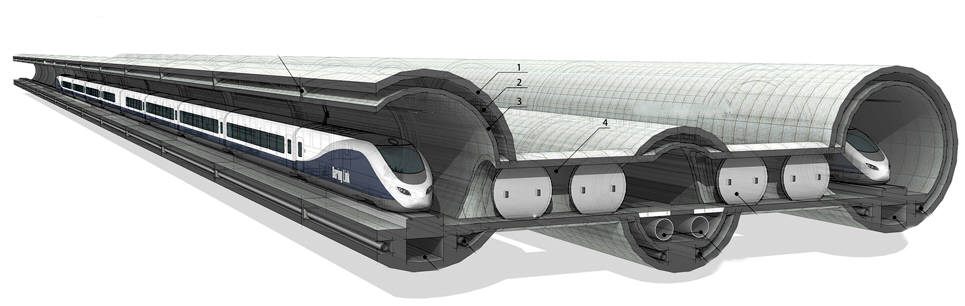
William Gilpin was an American explorer, political leader, and early geopolitical thinker whose writings on continental development anticipated the global infrastructure debates of the modern era. Best known for his book “The Cosmopolitan Railway: Compacting and Fusing Together All the World’s Continents” (1890), Gilpin became the first serious world researcher — and notably an American — to publish a comprehensive work advocating the physical connection of North America and Asia by bridge or tunnel across the Bering Strait.
In this sweeping study, Gilpin envisioned a Cosmopolitan Railway capable of knitting continents together and reshaping civilization itself. He argued that such a system would unite North America, Europe, and Asia into a continuous overland network, transforming trade, culture, migration, and political development. His analysis extended from the Missouri River to the Pacific Coast, across the Bering Strait, and onward into Asia — establishing the intellectual foundation for more than a century and a half of discussion about linking Alaska and Chukotka, the United States and Russia.
The book is organized into major thematic chapters — The Physical Aspect, The Political Aspect, The Social Aspect, The Financial Question, History of Railway Construction, The Railway as a Factor of Progress, Race Problems and Proclivities, Retrospective, Prospective, Emigration and Immigration, and The New Civilization — combining geography, geology, climate science, economic reasoning, and historical reflection into a unified strategic vision.
Drawing on his lifelong study of continental geography and population movements, Gilpin examined how landforms, climate zones, and ocean barriers influence the rise and succession of civilizations. He proposed that railways were not merely transport systems but engines of historical transformation — instruments capable of fusing peoples, expanding commerce, and accelerating human progress. His arguments blended practical considerations of engineering feasibility with broader philosophical reflections on settlement patterns, trade routes, and national development.
Subsequent theoretical and technical works by economists, engineers, transport planners, and geopolitical researchers throughout the twentieth and twenty-first centuries — many of which are documented on this page — trace their intellectual lineage to Gilpin’s foundational vision. His 1890 volume opened the long-running global discussion on intercontinental rail integration and remains the earliest systematic proposal to connect the American and Eurasian landmasses.
The Cosmopolitan Railway continues to be available in modern reprint editions and stands as the seminal text initiating the enduring concept of a Bering Strait bridge or tunnel as part of a unified world railway system.