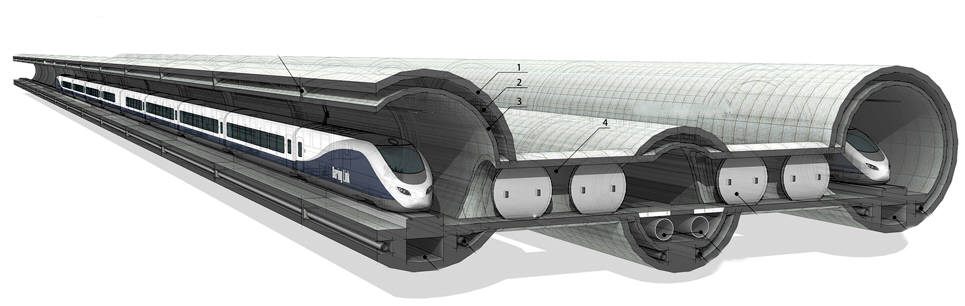
Bering Strait tunnel:
pipe dream or game-changer for US-Russia-China ties?
• Now that a US-Canada rail line has been approved, there are fresh hopes that a link can finally be built across the icy 85km strait
• Detractors point to its huge potential cost, but backers see potential for a global shipping nexus and a new era of international cooperation
By Ed Peters

A dog sled team travels across the snow-covered landscape of
Denali National Park and Preserve,
Alaska, illustrating the demanding winter conditions that offer a sense of
the challenges facing a future transportation corridor between Alaska and
Chukotka. Such conditions highlight the engineering challenges surrounding
proposals to connect Asia and North America through a future Bering Strait
tunnel and transcontinental rail link.
Photo: Jacob W. Frank,
Corrie Mile 9 Landscape,
February 24, 2013; Denali National Park and Preserve / National Park Service.
Source and licensing:
Wikimedia Commons.
Listed under
Creative Commons Attribution 2.0 Generic (CC BY 2.0)
and identified as public domain in the United States as an official
National Park Service work.
Click the image to zoom
When US President
Donald Trump bestowed his approval on a new US$22 billion, 2,400km railway between the United States and Canada
last month, it brought a glimmer of hope to an even bigger and bolder infrastructure project.
The idea of joining up the far east of Russia with the far north of the US - either by tunnel or bridge - has been tantalising engineers, entrepreneurs and downright dreamers since the end of the 19th century.
More recently, in the 1960s,
Chinese-American structural engineer Tung Yen Lin
drew up detailed plans for an "Intercontinental Peace Bridge" across the Bering Strait, which he envisioned as a symbol of international cooperation as well as an important trade route.
The Trump-approved Alaska to Alberta, or A2A, rail project is being hailed as an important link in the chain across the apex of the Pacific Rim, one that could eventually spawn a vast transport network connecting Asia directly with the Americas, through the strait.
Fyodor Soloview, founder of
Anchorage-based InterBering, a private company dedicated to lobbying for the link
, said there was a "significant body of interest, both Russian and American, in building a Bering Strait link", before adding that he thought the "the main beneficiary would be China – the main global shipper of products – and its vast railway network".
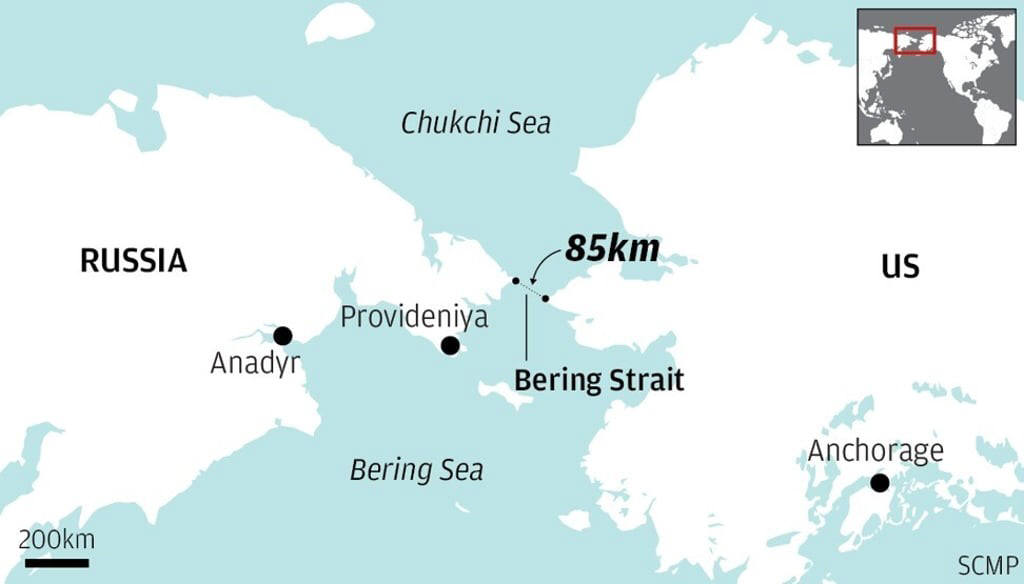 The area surrounding the Bering Strait.
Click the image to zoom.
While the link would augment China's Belt and Road global infrastructure initiative, prompting concerns from the US - which is involved in a trade battle with China and views the
Belt and Road Initiative
as a leveraged power play - its potential long-term benefits would most likely be seen by all concerned parties as an eventual boon for trade relations. Russia, especially, is intent on building its trade with China.
"The project's a long way from breaking ground, but the announcement about A2A is a great step forward," Soloview said.
Article presented by InterBering Management — Fyodor Soloview, President